
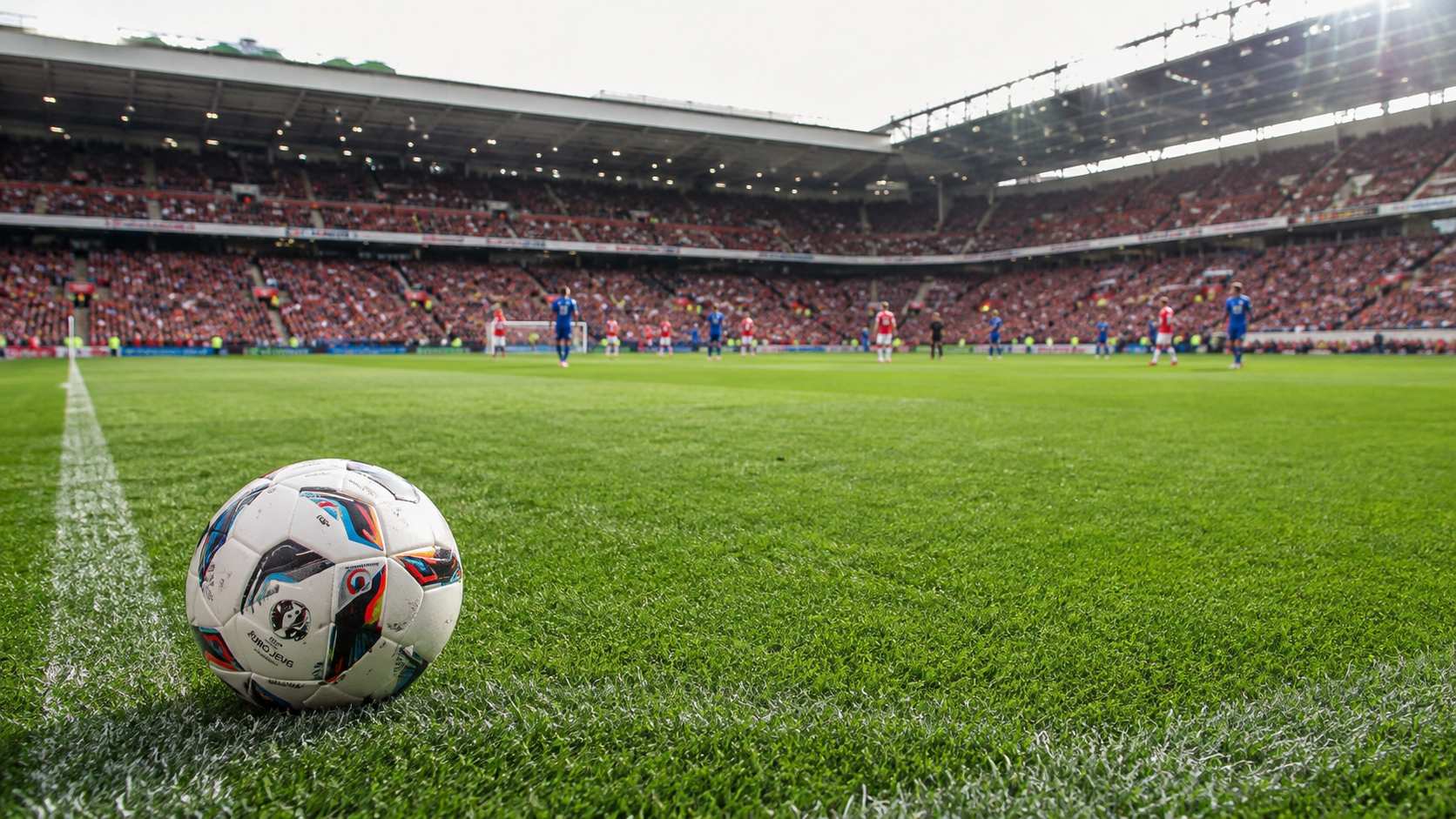
Football is the simplest of the major team games to describe and one of the hardest to do well. Two teams of eleven try to put a ball into the other team's goal, using any part of the body except the hands and arms. Everything else – the offside law, the formations, the arguments – sits on top of that one sentence.
The aim of the game
Whichever side scores more goals wins. A goal counts when the whole of the ball crosses the whole of the goal line between the posts and under the bar. Not most of it, not the part the striker can see: all of it. This is why goal-line decisions are so often closer than they look from the stands.
If both sides score the same number, the match is drawn. In a league that is worth a point to each; in a knockout competition it usually means extra time, and then penalties.
The pitch, the goals and the markings
A full-size pitch is between 90 and 120 metres long and 45 to 90 metres wide, which is a much wider range than most people expect. Professional grounds sit near the top of it. Junior football is played on smaller pitches with smaller goals, and that is deliberate rather than a compromise.
The markings you need to know are few. The penalty area, 16.5 metres out from the goal line, is where the goalkeeper may handle the ball and where a foul by the defending side results in a penalty kick. The penalty spot is 11 metres from the goal line. The centre circle marks the distance opponents must stand back at a kick-off. Everything else is a boundary.
How long a match lasts
Two halves of 45 minutes, with a break of no more than 15 minutes between them. The referee adds time at the end of each half to account for substitutions, injuries, goal celebrations and time-wasting, and that added time has grown considerably in recent seasons. Youth football uses shorter halves, scaled to the age group.
Starting and restarting play
Play begins with a kick-off from the centre spot, and restarts the same way after every goal. Beyond that, the restarts follow from how the ball left play:
- Throw-in – the ball crossed a touchline. Taken by the team that did not touch it last, with both feet on the ground and the ball delivered from behind and over the head.
- Goal kick – the ball crossed the goal line off an attacker. Taken from inside the six-yard box, and it may now be played to a teammate standing inside the penalty area.
- Corner kick – the ball crossed the goal line off a defender.
- Free kick – awarded for a foul. Direct free kicks can be scored from without anyone else touching the ball; indirect ones cannot.
- Penalty kick – a direct free kick offence committed by the defending side inside its own penalty area.
The three laws that cause most of the arguments
Offside. A player is in an offside position if they are in the opponents' half and nearer to the opponents' goal line than both the ball and the second-last opponent. Being there is not an offence. It only becomes one if they are involved in play at the moment a teammate plays the ball. Level is onside, and there is no offside from a throw-in, a goal kick or a corner.
Handball. The test is not whether the ball hit an arm but whether the arm was where it had no business being. Deliberately handling the ball is an offence, as is making the body unnaturally bigger with the arm. Separately, a goal scored off an attacker's hand or arm is disallowed even when it was entirely accidental.
Fouls. Charging, jumping at, kicking, pushing, tripping or holding an opponent is a foul if done carelessly, recklessly or with excessive force. A tackle that takes the ball cleanly is legal; a tackle that takes the ball and then the player usually is not.
The officials
A referee runs the game and has the final say on every point of fact. Two assistant referees patrol the touchlines and flag for offside and for the ball leaving play. A yellow card is a formal caution; a red card means the player leaves the field and is not replaced, so the side plays on with ten. Two yellows in one match add up to a red.
What to work on first
Nobody joins a team and immediately worries about the offside trap. The things that make you useful in your first month are unglamorous:
- Controlling the ball. A first touch that keeps the ball within a stride buys you the second and a half you need to look up.
- Passing with the inside of the foot. Accurate, repeatable and the pass you will play most often.
- Running with the ball at a jog. Small touches, head up. Speed comes later.
- Moving when you do not have it. Most of a match is spent without the ball, and finding space is a skill in itself.
The quickest way to learn the rest is to play. Grassroots clubs take adult beginners far more often than people assume, and a single training session will teach you more about where to stand than any amount of reading.